

Aggregate crushing is a multi-stage industrial process that transforms blasted or excavated rock into graded construction materials for concrete, asphalt, road foundations, and infrastructure projects. An efficient quarry crushing plant must achieve the required particle-size distribution, high production capacity, consistent particle shape, and minimum operating costs. Successful plant design depends on geological characteristics, crusher selection, circuit configuration, screening efficiency, and effective dust and fines management.
1. Primary Scalping and Crushing
The process begins with blasted rock delivered by haul trucks to a receiving hopper. A vibrating grizzly feeder regulates material flow and performs primary scalping, separating fine particles and soil before they enter the primary crusher. This prevents unnecessary crusher loading, reduces wear, and improves throughput.
For hard, abrasive igneous rocks such as granite and basalt, a deep-cavity jaw crusher is generally preferred. Its compression-based crushing mechanism provides reliable reduction of large feed rocks while maintaining relatively low wear compared with impact-based alternatives.
The jaw crusher reduces run-of-quarry material, commonly from 600–1,000 mm to approximately 100–200 mm, depending on feed characteristics and machine configuration. Primary crusher selection must consider maximum feed size, compressive strength, abrasiveness, moisture content, and required capacity.
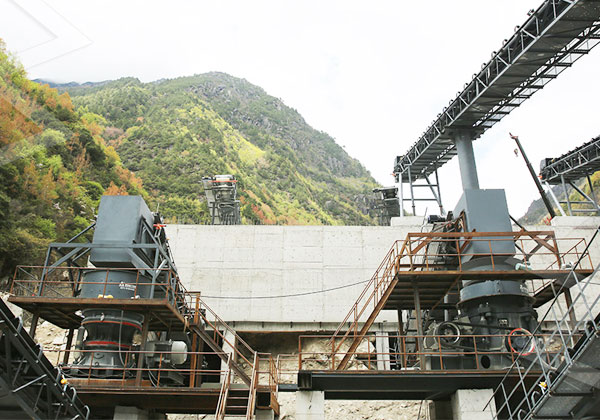
2. Secondary and Tertiary Crushing
After primary reduction, material is transported by conveyor to secondary crushing. For granite and basalt, multi-cylinder hydraulic cone crushers provide effective compression crushing, producing controlled product sizes while accommodating variations in feed conditions.
Cone crushers are particularly suitable for abrasive materials because their crushing chambers generate inter-particle compression and reduce excessive metal-to-rock impact. Hydraulic adjustment also enables operators to optimize the closed-side setting (CSS), which directly influences product gradation, throughput, and particle shape.
Tertiary crushing further reduces material to meet demanding aggregate specifications. Depending on the required final products, cone crushers or vertical shaft impact (VSI) crushers can be incorporated. Cone crushers provide additional size reduction, while VSI equipment improves particle shape through rock-on-rock or rock-on-steel impact.
For low-abrasion sedimentary deposits, particularly limestone, high-speed horizontal shaft impact (HSI) crushers offer an alternative. Their high reduction ratios can simplify the crushing circuit and produce well-shaped aggregates. However, increased wear and operating costs must be considered when processing highly abrasive rock.
3. Closed-Circuit Recirculation and Mass Balance
Closed-circuit crushing is essential for maintaining consistent product sizing and maximizing plant efficiency. In this arrangement, crushed material passes through a screening unit, with oversized particles returned to the crusher for further reduction.
The circulating load is a critical design parameter. Excessive recirculation increases conveyor loading, energy consumption, and crusher wear, while insufficient recirculation can allow oversized particles into finished products.
Mass balance calculations should account for fresh feed, crusher discharge, screen efficiency, circulating load, and final product streams. Crusher CSS adjustments must be coordinated with screen aperture sizes to maintain stable production.
Operators should monitor feed rate, motor power, crusher pressure, discharge gradation, and conveyor loading. Automated process-control systems can adjust feeder speeds and crusher settings to respond to changing feed conditions.
4. Tertiary and Quaternary Cubical Shaping
Particle shape is particularly important for asphalt and high-performance concrete applications. Flat and elongated particles can reduce aggregate interlock, increase void content, and negatively affect pavement durability.
VSI crushers are widely used for tertiary or quaternary shaping because their high-velocity impact mechanism improves particle cubicality and surface texture. Rock-on-rock configurations are especially advantageous when processing abrasive granite and basalt because they reduce direct wear on metallic components.
The VSI feed must be appropriately sized and consistently distributed. Excessive fines, uneven feed distribution, and incorrect rotor speed can reduce shaping efficiency and increase energy consumption.
A properly configured shaping stage improves aggregate quality while minimizing unnecessary recirculation and excessive production of micro-fines.
5. Multi-Deck Screening and Washing
Multi-deck vibrating screens separate crushed material into commercial size fractions, such as 0–5 mm, 5–10 mm, 10–20 mm, and 20–40 mm. Screen aperture selection depends on product specifications and required production volumes.
Each screen deck performs a different classification function. Effective screening requires suitable vibration amplitude, frequency, inclination, feed distribution, and adequate screening area.
Where aggregates contain clay, silt, or excessive dust, washing systems can be integrated. Log washers, scrubbers, sand screws, and hydrocyclones remove unwanted contaminants and improve product cleanliness.
Particular attention should be given to micro-fines smaller than 63 µm. Excessive micro-fines can affect concrete water demand, asphalt binder requirements, and aggregate performance. Hydrocyclones and controlled dewatering systems help separate fine particles while allowing useful sand fractions to be recovered.
6. Geological Selection, Dust Control, and Operational Optimization
The geological properties of the deposit determine the most suitable crushing flowsheet.
For hard, abrasive igneous rocks, a compression-based configuration consisting of a deep-cavity jaw crusher, multi-cylinder hydraulic cone crusher, and VSI shaping stage is generally effective. For softer, less abrasive limestone deposits, an HSI-based configuration can deliver higher reduction ratios and simplified processing.
Dust suppression must be integrated throughout the plant. Water sprays at transfer points, enclosed conveyor systems, extraction units, and baghouse filters reduce airborne particulate emissions. Washing and water-recycling systems should be designed to manage suspended solids and minimize water consumption.
Continuous monitoring of CSS, circulating load, screen efficiency, particle shape, and micro-fines content ensures that the plant operates within production and quality targets.
Conclusion
An efficient quarry aggregate crushing plant requires coordinated engineering across primary reduction, secondary and tertiary crushing, closed-circuit recirculation, cubical shaping, and final screening or washing. Matching crusher technology to geological characteristics is fundamental to controlling wear, energy consumption, and product quality. Through optimized CSS settings, accurate mass balance, effective fines management, and automated process monitoring, quarry operators can achieve consistent aggregate production, improved equipment availability, and long-term operational efficiency.