

In the global high-end construction aggregate sector, producing high-quality manufactured sand (M-Sand) from river pebbles presents a unique set of mechanical and systemic challenges. River pebbles possess high hardness and significant abrasiveness, which traditionally lead to escalated wear part consumption. As a Solution Architect, the objective is to engineer a highly efficient material flow that minimizes operational costs while strictly maintaining the required Fineness Modulus and achieving a superior Cubical Particle Shape.
The Core Solution: “Stone-on-Stone” Crushing Principle
To mitigate the aggressive wear characteristics of river pebbles, the deployment of a Vertical Shaft Impact (VSI) crusher is mandatory. The VSI6X series operates on a specialized “Stone-on-Stone” crushing principle. By utilizing the kinetic energy of the rock itself, the material forms a protective autogenous lining inside the crushing chamber. This systemic approach drastically reduces the physical contact between the abrasive river pebbles and the machine’s internal alloy components, systematically driving down long-term wear costs. Furthermore, the high-velocity impact cleavage guarantees an optimal cubical particle shape, eliminating structural weaknesses in the final aggregate matrix.
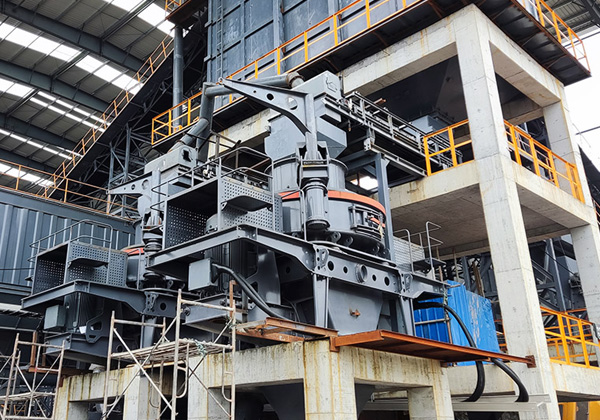
Technical Constraints and System Throughput: VSI6X1263
At the heart of the proposed architecture is the VSI6X1263 Sand Making Machine. The integration of this unit provides necessary throughput capacities balanced with energy efficiency.
- Maximum Feed Size: Engineered to accept feed materials up to 50mm, perfectly bridging the gap from secondary cone crushers.
- Power Configuration: Driven by a dual-motor setup (2x315kW) to ensure continuous kinetic stability under heavy loads.
- Rotor Dynamics: Features an advanced “Four-opening” rotor design. This architectural enhancement increases the material pass-through rate significantly, optimizing overall system capacity without expanding the physical footprint.
Closed-Circuit Screening Logic for Gradation Control
Achieving a consistent Fineness Modulus is not merely a function of crushing, but of rigorous Gradation Control. The system architecture must incorporate a closed-circuit screening logic. Post-crushing, the material is routed to a multi-deck vibrating screen. Precisely sized meshes isolate the target M-Sand, while oversized river pebble fragments are continuously recirculated back into the VSI6X1263. This closed-loop iteration ensures that 100% of the final product falls within the strict geometric parameters required by high-end concrete formulations, preventing “out-of-spec” waste.
Integration of XSD Sand Washers for Silt Removal
The final phase of the material flow involves necessary silt removal and aggregate polishing. The crushing process inherently generates a minor percentage of micro-fines. By integrating XSD Sand Washers into the tail end of the production line, the system effectively washes away excess stone powder and adhering impurities. This wheel-type washing mechanism ensures the final river pebble M-Sand exhibits an optimal cleanliness index, maximizing the bonding strength of the resulting concrete mix.
Technical FAQ: River Pebble M-Sand Systems
- Why is the “Stone-on-Stone” principle critical for river pebble crushing?
- River pebbles are highly abrasive. “Stone-on-Stone” kinematics use a material lining to crush the rocks against each other, isolating the wear from the machine’s steel components and drastically reducing OPEX.
- How does the VSI6X series improve throughput over older models?
- The VSI6X series, such as the VSI6X1263, utilizes an upgraded “Four-opening” rotor design. This architecture increases the volumetric flow rate of the feed material, boosting crushing efficiency and overall tonnage.
- What is the role of the closed-circuit system in controlling Fineness Modulus?
- A closed-circuit system ensures rigorous Gradation Control by forcibly recirculating oversized materials back to the crusher. This continuous loop prevents erratic sizing and guarantees a consistent, standardized Fineness Modulus.