

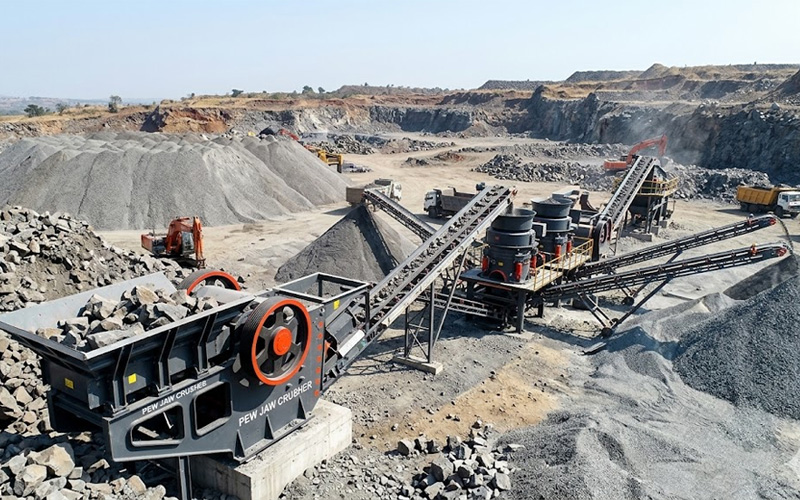
Producing high-quality road base materials from basalt—a dense, volcanic rock known for its high compressive strength and extreme abrasiveness—requires a sophisticated engineering approach. For highway infrastructure, the final aggregate must meet stringent requirements regarding cubicity, gradation curves, and the flakiness and elongation index. As a Solution Architect, I recommend an integrated circuit featuring the PEW Series European Jaw Crusher for primary reduction and the HPT Multi-cylinder Hydraulic Cone Crusher for secondary and tertiary stages to ensure high-volume stability and product quality.
1. Primary Stage: Robust Reduction with PEW Series
The primary stage is the foundation of the circuit’s throughput. In basaltic environments, the primary crusher must withstand high impact loads while maintaining a consistent discharge for downstream processes. The PEW Series Jaw Crusher is engineered for this role, offering a robust V-shaped crushing chamber and a heavy-duty eccentric shaft.
For high-capacity operations, models like the PEW1100 provide a Max_Feed of 940mm and a capacity of up to 650 t/h. This initial reduction ensures that the abrasive basalt is broken down efficiently, managing abrasiveness management right from the start to prevent premature wear on secondary liners. The adjustable discharge range allows for precise inter-stage synchronization, preventing bottlenecks at the secondary feeder.
2. Secondary and Tertiary Stages: Shape Control via HPT Laminated Crushing
The critical factor in road base quality is the laminated crushing principle. Conventional single-cylinder cones often produce flaky material when processing hard basalt. However, the HPT Multi-cylinder Cone Crusher utilizes a high-stroke, high-frequency design that promotes material-on-material crushing within the chamber.
- Cubicity and Gradation: The HPT series excels at gradation curve optimization. By maintaining a full crushing chamber, the HPT500 (powered by a 400kW motor) produces a highly cubical aggregate with a significantly lower flakiness index compared to traditional methods.
- Sub-grade Specifications: This process ensures the material meets the tight tolerances required for sub-base course specifications and high-grade asphalt concrete.
- High-Volume Stability: With a capacity range reaching up to 790 t/h for the HPT500, this unit handles the recirculating load of a closed-circuit screening system without compromising on output quality.
3. System Integration and Quality Balance
A successful basalt crushing plant is not just a collection of machines but a synchronized system. Achieving a zero-bottleneck flow requires balancing the capacity of the PEW primary with the HPT secondary/tertiary stages. Using high-efficiency vibrating screens in a closed loop allows for the separation of specific road base sizes (e.g., 0-5mm, 5-10mm, 10-20mm) while returning over-sized basalt for further shape correction in the HPT cone.
Technical Performance Matrix for Basalt Circuit
| Stage | Equipment Model | Max Feed (mm) | Power (kW) | Capacity (t/h) |
|---|---|---|---|---|
| Primary | PEW1100 Jaw | 940 | 185 | 300-650 |
| Secondary | HPT500 Cone | 330 | 400 | 220-790 |
| Tertiary (Optional) | HPT300 Cone | 230 | 250 | 110-440 |
Frequently Asked Questions
- How does the HPT series improve the flakiness index in basalt?
- The HPT Multi-cylinder Cone Crusher utilizes the “laminated crushing” principle, where material is crushed against other material rather than just the liners. This promotes a cubical particle shape and reduces the flakiness and elongation index, which is vital for road compaction.
- Why choose a PEW Jaw Crusher over a standard jaw for basalt?
- Basalt is highly abrasive. The PEW series features a more robust structural design, higher-grade manganese liners, and a more efficient crushing angle, making it better suited for the high-wear conditions of basaltic quarries compared to standard models.
- What is the benefit of a closed-circuit screening system in this plant?
- Closed-circuit screening ensures that 100% of the material meets the specified size before leaving the plant. For road base materials, this is crucial for maintaining a precise gradation curve and ensuring the structural integrity of the final road surface.