
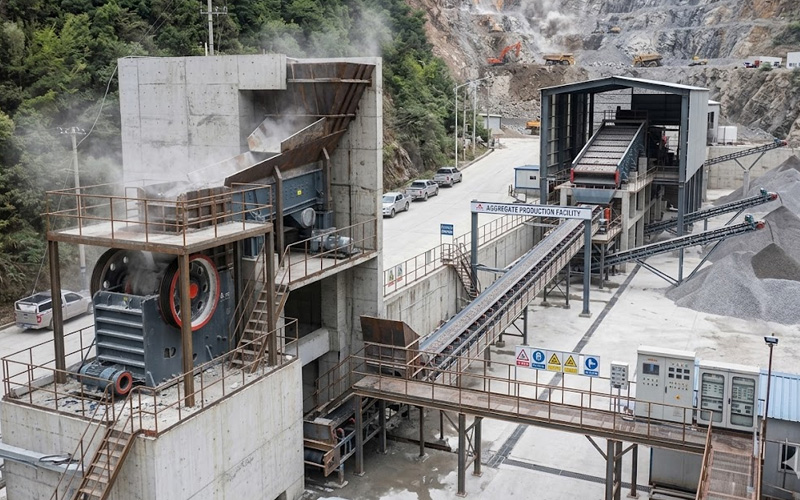
A 150-ton/hour stone crushing plant is a medium-scale aggregate production system designed to process approximately 150 metric tons of raw material per hour under suitable operating conditions. Achieving this capacity requires more than selecting a crusher with a nominal rating of 150 TPH. The entire production line—including feeding, primary crushing, secondary crushing, screening, conveying, and material recirculation—must be engineered to maintain balanced throughput.
A typical 150 TPH stone crushing plant uses a multi-stage configuration consisting of a vibrating grizzly feeder, primary jaw crusher, secondary cone or impact crusher, multi-deck vibrating screens, and belt conveyors. Equipment selection depends on feed size, rock compressive strength, silica content, desired aggregate sizes, and operating conditions.
1. Primary Jaw Crusher Specifications
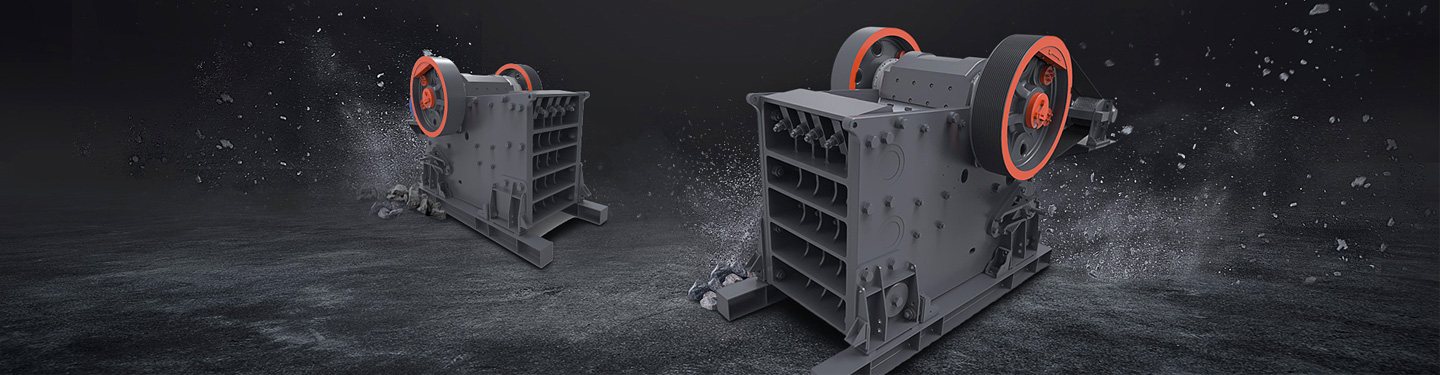
The primary jaw crusher reduces large raw stones into manageable particles for secondary crushing. For a 150 TPH production line, jaw crushers in the 600×900 mm to 750×1060 mm feed-opening class are commonly considered.
Models such as the C6X Series provide configurations suitable for demanding primary crushing applications.
Typical primary jaw crusher specifications:
| Technical parameter | Recommended specification |
|---|---|
| Feed opening | 600×900–750×1060 mm |
| Maximum feed size | 500–630 mm, model-dependent |
| Processing capacity | Approximately 100–200 TPH |
| Closed-side setting (CSS) | Approximately 75–200 mm |
| Motor power | 75–110 kW |
| Crushing mechanism | Compression |
| Discharge adjustment | Hydraulic or mechanical |
| Application | Granite, basalt, limestone, and other rocks |
The actual CSS should be selected according to the secondary crusher’s feed requirements and the required production gradation. A smaller CSS produces finer discharge but generally increases crushing resistance, power consumption, and wear.
For a 150 TPH installation, the jaw crusher should have sufficient capacity headroom to accommodate variations in feed characteristics and temporary production fluctuations.
2. Secondary Crusher Selection: Cone or Impact
Secondary crushing is essential for achieving the required aggregate particle sizes and controlling product shape. The optimal configuration depends primarily on rock hardness, compressive strength, and silica abrasiveness.
A. HST/HPT Hydraulic Cone Crushers for Hard Rock
For high-strength materials such as granite, basalt, and quartz-rich stone, hydraulic cone crushers are generally preferred.
HST single-cylinder and HPT multi-cylinder hydraulic cone crushers use compression crushing to reduce hard materials efficiently.
Typical engineering considerations:
- Suitable for medium-to-high-strength and abrasive rock.
- Designed for continuous secondary or tertiary crushing.
- Adjustable CSS allows control over product size.
- Hydraulic protection helps manage uncrushable material.
- Wear-resistant liners improve operating reliability.
For a 150 TPH plant processing hard rock, an appropriately sized cone crusher should be selected based on the jaw crusher’s actual discharge gradation rather than nominal plant capacity alone.
B. CI5X Impact Crushers for Medium-Hard Limestone
For limestone and other medium-hard, moderately abrasive materials, CI5X impact crushers can provide an effective secondary crushing solution.
Impact crushers use high-speed rotor-mounted blow bars to break material through impact and collision.
Their principal advantages include:
- Good particle shape and improved cubicity.
- High reduction ratios.
- Effective production of manufactured sand feed and graded aggregates.
- Adjustable impact gaps for product-size control.
However, high-silica materials can accelerate blow-bar and impact-liner wear. Consequently, impact crushing is generally more economical for medium-hard, lower-abrasiveness materials than for highly abrasive granite or basalt.
3. Vibrating Grizzly Feeder and Surge Buffering
The vibrating grizzly feeder regulates the flow of raw material into the primary jaw crusher while removing undersized particles before crushing.
For a 150 TPH plant, the feeder should be selected to deliver approximately 165–180 TPH under normal operating conditions, providing operational headroom.
Important specifications include:
- Adjustable feeding rate.
- Heavy-duty wear-resistant grizzly bars.
- Screening gaps suitable for bypassing fines.
- Variable-frequency drive for feed-rate regulation.
- Construction capable of handling large, irregular rocks.
A surge hopper or buffer bin between the feeder and jaw crusher helps stabilize material delivery. Additional buffering between crushing stages can prevent temporary fluctuations from disrupting the secondary crushing and screening processes.
A properly designed surge system also reduces crusher starvation and excessive loading.
4. Closed-Circuit Screening with S5X Vibrating Screens
Screening determines the final aggregate gradations and controls the circulating load within the crushing circuit.
S5X Series vibrating screens are suitable for multi-deck screening applications requiring high screening efficiency and stable operation.
A typical configuration uses a three- or four-deck screen to separate material into several commercial aggregate fractions.
For example, the screen may produce:
- 0–5 mm: Manufactured sand or fine aggregate.
- 5–10 mm: Fine aggregate.
- 10–20 mm: Medium aggregate.
- 20–31.5 mm: Coarse aggregate.
Oversized material is returned to the secondary crusher through a closed-circuit conveyor arrangement. This ensures that particles exceeding the target specification are crushed again rather than entering the final product stockpiles.
Screen aperture sizes, inclination, vibration frequency, and deck area must be selected according to material moisture, particle shape, and required product distribution.
Balanced circulating loads are particularly important. Excessive recirculation reduces effective plant throughput, increases power consumption, and accelerates wear.
5. Recommended 150 TPH Equipment Configuration
A practical production-line arrangement is:
| Equipment | Recommended configuration |
|---|---|
| Vibrating grizzly feeder | Heavy-duty, approximately 165–180 TPH |
| Primary jaw crusher | C6X-class, 600×900 or 750×1060 mm |
| Secondary crusher | HST/HPT cone or CI5X impact |
| Vibrating screen | S5X, three or four decks |
| Surge hopper | Sized according to feed variability |
| Belt conveyors | Sized for peak operating throughput |
| Electrical system | Centralized control and protection |
The production sequence is:
Raw material → Grizzly feeder → Jaw crusher → Secondary crusher → Multi-deck vibrating screen → Finished aggregate stockpiles.
Screen oversize returns to the secondary crusher for additional reduction.
6. Power Consumption and Operational Considerations
A 150 TPH crushing plant requires coordinated electrical and mechanical design. The primary jaw crusher typically uses a 75–110 kW motor, while secondary crushers, vibrating screens, feeders, and conveyors contribute additional installed power.
Actual energy consumption depends on rock hardness, feed distribution, CSS settings, moisture, and circulating load.
Engineers should also account for:
- Dust suppression and collection systems.
- Equipment foundations and vibration isolation.
- Lubrication and hydraulic systems.
- Wear-part replacement schedules.
- Electrical interlocks and emergency shutdowns.
- Preventive maintenance and equipment availability.
Capacity calculations should distinguish between instantaneous crusher capacity and sustained saleable production. A plant rated at 150 TPH may require higher instantaneous crushing capacity to compensate for screening recirculation and operational downtime.
Conclusion
A reliable 150-ton/hour stone crushing plant requires an integrated equipment configuration rather than a single high-capacity crusher. A properly sized 600×900–750×1060 mm primary jaw crusher, paired with HST/HPT cone crushers for abrasive hard rock or CI5X impact crushers for medium-hard limestone, provides a suitable foundation.
Combined with correctly sized vibrating grizzly feeders, surge buffering, S5X multi-deck vibrating screens, and balanced closed-circuit conveyors, the system can deliver consistent aggregate gradations and sustained production.
Ultimately, achieving 150 TPH depends on matching every processing stage to the material characteristics, feed conditions, and final product requirements. Detailed engineering calculations and manufacturer performance testing should confirm the final equipment selection before installation.