
Producing high-purity quartz sand from hard, silica-rich feedstock demands more than simply reducing particle size. Quartz has a Mohs hardness of about 7, and conventional compression crushing can generate excessive fines, irregular fractures, and internal damage that compromises the quality of the final sand. Vertical shaft impact (VSI) crushers address these challenges through a fundamentally different mechanism: high-velocity particle acceleration followed by controlled rock-on-rock collision.
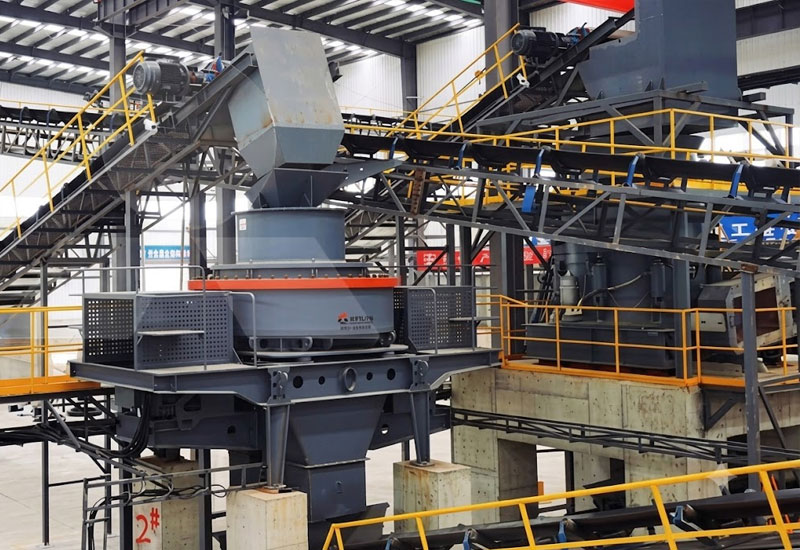
In VSI systems such as the VSI5X and VSI6X series, the rotor is the central element governing the crushing physics. Feed material enters the rotor, is accelerated radially by centrifugal force, and exits through the rotor ports at high velocity. Instead of relying primarily on compression between metallic surfaces, the process uses the kinetic energy of particles themselves. Quartz particles collide with other quartz particles or with a carefully controlled crushing chamber environment, producing selective impact fragmentation.
Rock-on-Rock Collision Dynamics
The effectiveness of VSI crushing depends on converting rotor speed into controlled impact energy. A particle leaving the rotor carries kinetic energy proportional to its mass and the square of its velocity. Consequently, relatively small increases in peripheral speed can substantially increase impact intensity.
For high-silica quartz, however, maximum velocity is not automatically optimal. Excessive impact energy can produce large quantities of ultrafine material. The objective is instead to establish a velocity regime that preferentially breaks weak planes, grain boundaries, and surface defects while limiting unnecessary pulverization.
Rock-on-rock crushing provides an important advantage because the collision is distributed across the particle population rather than concentrated at a single metal contact point. Quartz grains impact one another at high speed, creating intense localized stresses. When those stresses exceed the material’s fracture threshold, cracks propagate through the grain and release a fragment. Properly controlled impact therefore promotes particle shaping and size reduction while reducing dependence on abrasive metal-to-rock contact.
Managing Micro-Fractures in Quartz
Internal micro-fractures are particularly important in high-purity quartz applications. A grain can appear intact after crushing while containing subsurface cracks generated by poorly controlled impact or compression. Such defects may weaken the grain during subsequent handling, classification, or thermal processing and can increase the production of unwanted fines.
VSI crushing cannot eliminate every microscopic defect inherent in natural quartz, but its impact-based mechanism can reduce the formation of unnecessary damage. Short-duration, high-energy collisions concentrate stress at discrete impact zones rather than maintaining prolonged compressive loading. This encourages fracture propagation where stress concentrations already exist.
Rotor design and operating stability are therefore critical. In advanced VSI configurations such as VSI6X, optimized internal flow and rotor geometry help maintain more consistent particle acceleration and collision conditions. Stable operation reduces fluctuations in impact energy, which can otherwise cause alternating under-crushing and over-crushing. The result is a narrower and more controllable fracture environment.
Extreme Hardness and Wear Mechanics
Quartz’s hardness creates a second major challenge: abrasive wear. Rotor tips, feed components, and impact surfaces are exposed to repeated high-speed contact with silica particles. If wear changes the rotor’s geometry significantly, the discharge trajectory and velocity distribution can also change, ultimately affecting product quality.
Modern VSI designs therefore treat wear management as part of the crushing process rather than merely a maintenance issue. Replaceable wear components and optimized material distribution help preserve the rotor’s operating profile. In VSI5X and VSI6X-type designs, maintaining the correct relationship between rotor speed, feed rate, tip condition, and crushing chamber configuration is essential.
Tip wear should be minimized without allowing worn components to alter particle trajectories excessively. Excessive wear can reduce acceleration efficiency and increase metal exposure to the material stream, while aggressive operating conditions can accelerate component degradation. The optimum condition is a stable wear pattern that maintains consistent particle velocity and rock-on-rock interaction.
Minimizing Fines While Preserving Purity
For quartz sand production, product purity is influenced not only by chemical composition but also by contamination introduced during crushing. Rock-on-rock operation minimizes direct metal-to-quartz contact, reducing the opportunity for metallic wear particles to enter the product. This is particularly valuable where high silica purity is required.
At the same time, controlling fines is a matter of energy balance. Excessive rotor speed, excessive recirculation, or an inappropriate feed gradation can push impact energy beyond the level required for useful size reduction. Proper feed preparation, controlled rotor speed, balanced chamber design, and timely removal of correctly sized particles can prevent unnecessary re-crushing.
The VSI therefore functions less like a conventional crusher and more like a controlled particle-acceleration system. Its performance depends on managing collision energy, fracture behavior, wear geometry, and material residence time as an integrated process.
Ultimately, VSI technology offers a strong route for high-hardness quartz sand production because it uses quartz itself as a major crushing medium. When rotor velocity and wear conditions are carefully controlled, rock-on-rock collisions can produce efficient liberation and shaping with limited metallic contamination, while avoiding excessive impact energy that would generate dust fines. For high-purity applications, this balance between fracture efficiency and damage control is the key to exploiting VSI5X and VSI6X technology with extremely hard, silica-rich feedstock.