

Portable Equipment for Stone Crushing Production: Accelerating Aggregate Velocity with Wheeled Mobile Plants
Traditional stationary stone crushing setups present massive bottlenecks for modern aggregate operations. Pouring thousands of tons of concrete foundations, waiting weeks for engineering permits, and committing to a single geographic location severely caps operational flexibility and delays initial material throughput. Portable equipment for stone crushing production completely rewrites this timeline. By mounting heavy industrial crushing infrastructure onto heavy-duty wheeled chassis, quarry operators can eliminate permanent civil engineering requirements and begin processing raw material within days of equipment arrival on site.
Shifting from fixed installations to highly integrated wheeled configurations transforms how aggregate projects are executed. Instead of hauling raw stone over long distances to a centralized plant, portable equipment moves the crushing station directly to the blasting face. This operational mobility eliminates expensive haul truck cycles, slashes fuel expenditures per shift, and ensures that material is processed at maximum velocity across multi-site production contracts.
Engineering Advantages of Wheeled Configurations over Fixed Installations
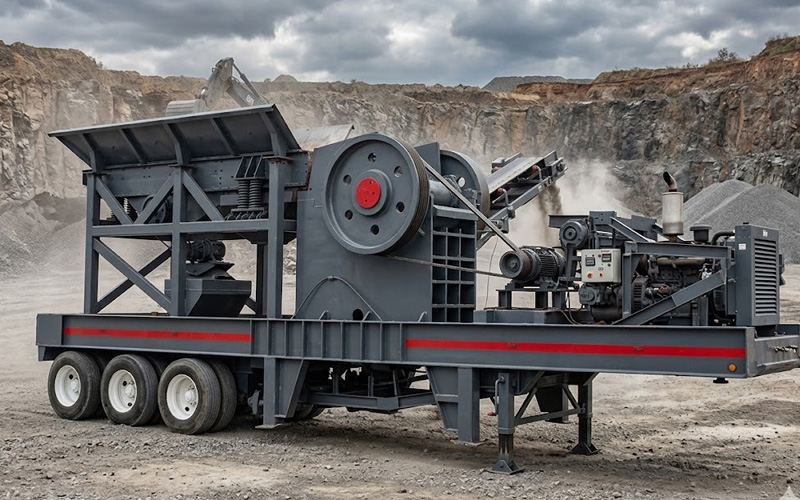
The primary advantage of portable equipment for stone crushing production lies in its integrated frame design. Fixed installations require deep excavation, concrete pouring, and structural steel reinforcement before a single rock can be broken. Wheeled mobile plants utilize an engineered, high-tensile steel chassis that absorbs the massive dynamic stresses generated during heavy primary and secondary crushing operations. Heavy-duty hydraulic landing legs deploy directly onto leveled ground, stabilizing the machine and creating a rigid, secure operational platform without a single drop of concrete.
Eliminating heavy foundation pouring directly accelerates capital payback velocity. When a project concludes, a stationary plant represents stranded capital trapped in concrete foundations and dismantled steel structures. A wheeled mobile plant is simply hitched to a prime mover and transported to the next assignment. This mobility ensures near-continuous equipment utilization, preserving the long-term asset value and turning setup time into active, revenue-generating production hours.
Multi-Stage Mobile Crushing Train Configuration
Achieving optimal cubical particle shape and maximum tonnage requires a synchronized multi-stage mobile crushing train. Raw run-of-mine stone must move seamlessly from primary reduction to secondary shaping and final sizing without manual handling bottlenecks or uncoordinated equipment speeds.
The Primary Reduction Stage
The crushing sequence begins at the primary wheeled station, where the raw, blasted rock enters the system. A heavy-duty vibrating feeder handles direct dumping from excavators or wheel loaders. The feeder actively scalps fine materials, bypassing them around the crushing chamber to reduce internal component wear. The remaining oversized material is fed directly into a high-capacity jaw crusher. Here, aggressive crushing dynamics reduce massive boulders down to a manageable transfer size, preparing the aggregate for secondary reduction.
The Secondary Sizing and Shaping Stage
Once the primary jaw crusher completes the initial reduction, a heavy-duty onboard conveyor discharges the material directly into the secondary wheeled crushing and screening station. This phase utilizes a high-performance multi-缸 (multi-cylinder) hydraulic cone crusher operating in a closed circuit with an integrated high-frequency vibrating screen. The material enters the cone chamber, where high-velocity compressive forces break the stone along its natural grain lines, maximizing the yield of cubical material and eliminating out-of-specification elongated fractions.
The Closed-Circuit Recirculation Flow
Material exiting the cone crusher is immediately deposited onto the integrated multi-deck vibrating screen. The screen deck separates the material into exact commercial sizes. Aggregates that meet the final product size specifications are directed to side stockpiling conveyors for immediate sale or dispatch. Any oversized material that fails to pass through the top screen deck is captured and automatically routed via a return conveyor back into the cone crusher chamber. This continuous closed-loop cycle guarantees 100% size control and prevents uncrushed material from contaminating the finished aggregate stockpiles.
Synchronized Equipment Matrix and Process Flow
To achieve maximum net production yield per hour, the primary and secondary mobile units must be precisely calibrated. The table below outlines the specific technical parameters and operational roles required to maintain mass balance across the mobile crushing train.
| Process Stage | Equipment Designation | Core Internal Components | Max Feed Size | Capacity Range | Power Rating | Operational Function |
|---|---|---|---|---|---|---|
| Primary Stage | NK75J Primary Mobile Plant | PE3040 Jaw Crusher & FK0936 Vibrating Feeder | 680 mm | 150–350 t/h | 141.4 kW | Receives run-of-mine rock; scalps fines via vibrating action; performs initial coarse reduction. |
| Secondary Stage | NK300H Secondary Mobile Plant (With Screening) | HPT300 Cone Crusher & SKX1536 Vibrating Screen | 220 mm | 110–440 t/h | 323.5 kW | Performs fine crushing; shapes aggregates; screens and recirculates oversize back to the cone. |
The process balance between these two units prevents material accumulation bottlenecks. The NK75J Primary Mobile Plant delivers a controlled material stream of under 220 mm, perfectly matching the maximum feed appetite of the downstream NK300H Secondary Mobile Plant. With the secondary station capable of scaling up to 440 tons per hour, it easily swallows the peak output of the primary jaw crusher, even during surges in feed velocity. This exact capacity matching ensures that the onboard conveyors run at optimal loading metrics without risk of material spillage or unexpected belt stoppage.
Maximizing Site Yields and Operational Efficiency
Operating a synchronized mobile train unlocks massive gains in net production yield per hour. Because the equipment is completely wheel-mounted, the entire configuration can follow the quarry face as mining advances. This proximity minimizes the cycle times of support equipment, allowing loaders to dump directly into the primary hopper rather than running long haul routes to a fixed plant site.
Maintenance velocity is similarly enhanced by the integrated design. Both the primary and secondary units feature centralized lubrication points and hydraulic adjustment mechanisms. For instance, adjusting the closed side setting on the HPT300 cone crusher is handled via a push-button hydraulic control panel rather than manual shim changes. This allows operators to compensate for liner wear or alter product size distributions on the fly, reducing scheduled maintenance windows to a few minutes per shift.
Eliminating stationary infrastructure constraints reduces the total initial equipment investment per site. Operators no longer need to write off major capital expenditures for site remediation, foundation demolition, or permanent structural erection when a deposit is exhausted. The portability of the configuration guarantees that your capital remains liquid, highly mobile, and always positioned where the highest production margins are realized.