

Gold ore beneficiation is a series of physical and chemical processes designed to recover gold efficiently while minimizing energy consumption, reagent use, and environmental impact. The appropriate equipment depends on ore hardness, gold particle size, mineral composition, and the degree of gold liberation. A typical processing plant integrates crushing, screening, grinding, gravity separation, flotation, and leaching into a coordinated circuit. Equipment selection and process design must be tailored to the specific characteristics of the ore.
Primary Crushing: C6X Series Jaw Crusher
The beneficiation process begins with primary crushing, which reduces large run-of-mine ore into smaller fragments suitable for downstream processing. The C6X Series jaw crusher performs this initial size-reduction stage through compression between a fixed jaw plate and a moving jaw plate.
Its principal functions include breaking large rocks, preparing feed for secondary crushing, and maintaining a relatively consistent product size. Robust construction and an optimized crushing chamber support reliable operation under demanding mining conditions. Effective primary crushing also helps stabilize material flow throughout the processing plant.
Secondary and Tertiary Crushing: HST/HPT Hydraulic Cone Crushers
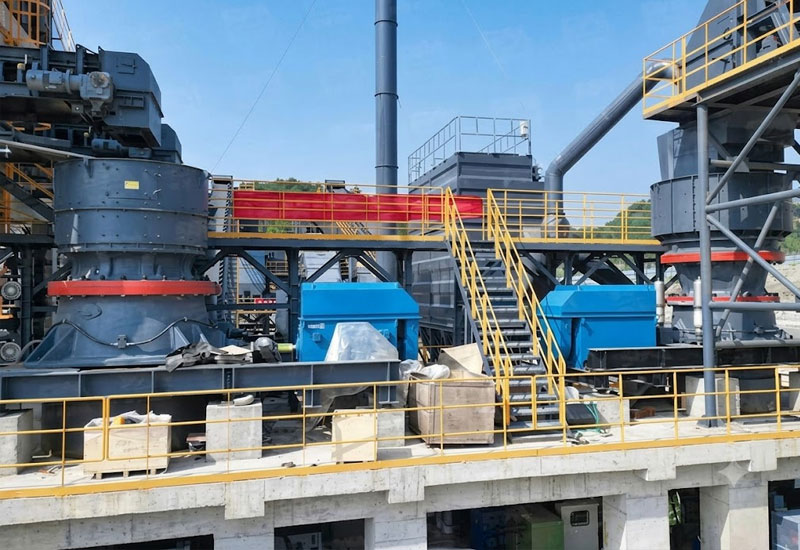
Following primary crushing, HST or HPT Series hydraulic cone crushers reduce the ore further. These machines use compression within a crushing chamber to produce smaller, more uniform particles.
HST cone crushers are commonly configured for secondary or tertiary crushing, while HPT cone crushers can support high-capacity, multi-stage crushing circuits. Hydraulic adjustment and protection systems facilitate operational control and help manage uncrushable material.
Multi-stage cone crushing improves feed consistency for grinding and can reduce the burden on downstream mills. However, crushing settings must be selected according to ore hardness, desired product size, and the liberation characteristics of the gold-bearing minerals.
Vibrating Screening: S5X Series Vibrating Screens
S5X Series vibrating screens classify crushed ore according to particle size. Installed after crushing stages, they separate material that meets the required size specification from oversize particles requiring further crushing.
In a closed-circuit arrangement, oversize material returns to the cone crusher, while appropriately sized material proceeds to the next stage. This arrangement helps prevent excessive crushing, improves circuit efficiency, and maintains a controlled feed size for grinding.
Screen aperture, vibration parameters, feed rate, and moisture content influence screening performance. Correct screen selection is particularly important when processing ores that generate excessive fines or contain moisture-sensitive material.
Fine Grinding Mills
After crushing and screening, the ore enters the grinding circuit. Ball mills, semi-autogenous grinding (SAG) mills, and other suitable grinding equipment reduce particle size sufficiently to liberate gold from its surrounding minerals.
Grinding is a critical stage because insufficient liberation can reduce recovery, whereas excessive grinding increases energy consumption and may create slimes that complicate separation. Grinding circuits may incorporate hydrocyclones or fine screens to classify particles and return coarse material for additional grinding.
The target grind size should be established through mineralogical analysis and laboratory testing rather than selected solely on equipment capacity.
Gravity Separation Equipment
Gravity separation exploits differences in density between gold and less-dense gangue minerals. Equipment such as centrifugal concentrators, shaking tables, and jigs can recover liberated gold particles without requiring chemical dissolution.
Centrifugal concentrators are particularly useful for recovering fine free gold, while jigs and shaking tables can separate suitable particle-size fractions. Gravity recovery is often incorporated into grinding circuits to capture gold early, reduce losses to tailings, and potentially lower downstream processing costs.
Its effectiveness depends on gold particle size, liberation, mineral density, and the presence of other heavy minerals.
Flotation Equipment
Flotation is commonly used when gold occurs alongside sulfide minerals, including pyrite and arsenopyrite. In flotation cells, air bubbles attach to suitably conditioned mineral particles, allowing selected minerals to rise into a froth layer for collection.
Reagents control mineral surface properties and improve separation selectivity. The resulting sulfide concentrate may contain a substantial proportion of the ore’s gold, enabling further treatment in a smaller processing stream.
Flotation performance depends on mineralogy, particle size, reagent selection, and water chemistry. It is generally less effective for recovering coarse, liberated gold than appropriately designed gravity separation.
Adapting the Flowsheet to Different Gold Ore Types
Beneficiation circuits must be adapted to the ore’s gold occurrence and mineralogy.
-
Placer and free-milling gold: Placer operations emphasize washing, screening, gravity concentration, and removal of unwanted heavy minerals. Hard-rock free-milling ores typically require crushing, grinding, gravity recovery, and sometimes direct cyanide leaching.
-
Sulfide-associated gold: These ores commonly require crushing, grinding, and flotation to concentrate gold-bearing sulfides. The concentrate may then undergo additional treatment to improve gold recovery.
-
Refractory gold: Gold locked within sulfides or associated with carbonaceous material may resist conventional leaching. Flotation concentration followed by pressure oxidation, roasting, or bio-oxidation may be necessary before gold extraction.
Gold ore beneficiation equipment performs complementary functions throughout the recovery process. C6X jaw crushers handle primary size reduction, HST/HPT cone crushers provide multi-stage crushing, S5X vibrating screens control particle classification, and grinding mills liberate gold-bearing minerals. Gravity separation, flotation, and leaching then recover gold according to its mineralogical characteristics. By matching equipment selection and circuit design to ore type, processing plants can improve recovery, control operating costs, and support safer, more sustainable gold production.